In this blog I will be showcasing Canada. Its culture, history, politics, lingo, cities and towns. Just your luck you get the Canadian perspective on our wonderful Great White North, eh?
**Disclaimer: Some opinions may be my own. (See first entry for details.)**
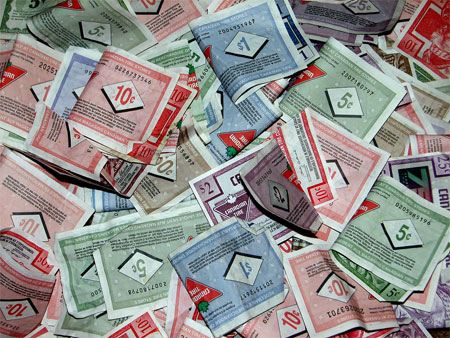
Not to be confused with actual Canadian currency, Canadian Tire Money is a currency that is only valid at Canadian Tire Stores. It is a sort of coupon loyalty. Each time you shop at Canadian Tire you will receive Canadian Tire money on top of your regular change. This can be saved up and then used to purchase more products at Canadian Tire. However it is the brunt of many Canadian jokes because any good Canadian knows it just collects in your kitchen drawer and never really gets used.
This was the slogan of French-Canadian reformers in Lower Canada when they demanded responsible government. They changed the name of their political party from Le Parti Canadien to the Patriote Party. This was a major snub to Britain because it was a reference to the Patriots in the American Revolution. As it turns out the British were not eager for a reminder of the Boston Tea Party or any subsequent events. In fact it was the American Revolution that made Britain so uneasy about giving Canadian colonists political power. The British Government believed it was their being to slack with the American colonies that had caused the Revolution when they introduced more cumbersome bills.
The Patriote Party, lead by L.J. Papineau drew up the 92 Resolutions, outlining their demands for control of revenue, responsible government and control of patronage. Lord John Russell, Colonial Secretary in British Government, responded with the 10 Resolutions, basically stating that there would be no changes and sending British troops into Lower Canada. The result was a more radical movement. The Sons of Liberty and other such groups sprang up. Protest meetings were held in the summer of 1837. There were riots and street fighting. British military commander Sir John (Yes everyone English was named John) Colburn was planning unrestrained military force against the reformers. The Richelieu district seemed a likely target! 800 Patriotes (only 200 armed) fought 300 British soldiers. Papineau runs to the United States at the first sign of trouble. 152 die. The Patriotes were butchered at St Dennis! Then at St Eustache martial law is imposed. 99 rebels are condemoned to death although only 12 were executed. 58 rebels were sent to Australia. Of all the fighting in Lower Canada there were a resulting 325 deaths, only 27 were British soldiers.
In Upper Canada it is much the same after the War of 1812-14 the colonists began to focus on the Alien Question. (The British Crown has instructed that no land be given to Americans, a problem for the Late Loyalists that stream into Upper Canada some time after the American Revolution. The British Crown also says that the Oath of Allegiance is not to be administered to Americans meaning that citizenship is in question for 50% of the population and these people are not allowed to vote). After 1815 new immigrants came from Britain, but they were well-educated and accustomed to British institutions. They are shocked to find that there is no responsible government in Upper Canada! Robert Gourlay does a survey in Upper Canada and calls for a commission of inquiry... but he is banished. His supporters fuel rebellions in Upper Canada.
---
Thus ends today's awesome Canadian history lesson! Hope you enjoyed!
It had been my intent to write a post about Canada Day on July 1st... because that is Canada Day. Of course being the patriotic Canadian that I am instead I spent the day making and eating pancakes, visiting Tim Horton's, wearing red and white and maple leaves and watching the fireworks in town with my friends.
So what is Canada Day? Originally called Dominion Day, this Canadian Holiday is the celebration of the anniversary of Canada's confederation in 1867.
Canadians celebrate this day mostly in a laid back manner. The main event in most communities is a public pancake breakfast or a giant cake unveiling in a park, often accompanied by games for young families and live music. In some communities there are fireworks in the evening. It is not uncommon to see people wearing red and white and an abundance of Canadian flags. There are Canadian flag hats, Canadian flag capes, Canadian flag tshirts, etc. Some people will paint their faces with red and white or die their hair or even play a frisbee game with a Canadian flag frisbee. Temporary tattoo Canadian flags are a staple and easy found in any dollar store throughout Canada. Despite the odd appearance of celebrators on Canada Day they do not usually do much more than hang out in the park or sit in the local pub with a beer and some friends.
Perhaps the most lively of Canada Day celebrations takes place on Parliament Hill in Ottawa. Thousands of Canadians make the pilgrimage to the Parliament buildings in order to listen to music, wear Canada flags and watch fireworks and possibly a performance by the Snowbirds.
There haven't been any entries here for awhile and for that I apologize. I had intended on doing an entry on maple syrup but I was waiting for the correct snow conditions to do this... you may wonder why but that's a surprise. At this point you'll have to wait until next year to find out.
With this possibility postponed I have been hatching a new one. Therefore this article is on Timbits. for those of you who don't know I recently was hired on at Tim Hortons and will soon have the inside perspective on all things Tim Hortons related.. including Timbits. But for now some facts and a lot of silliness:
What are Timbits you may ask? These tasty treats are donut holes and one of the trademark products of Tim Hortons. You can buy them separately or in boxes of 10, 20 or 40. They come in a varity of flavours. (Basically almost every flavour Tim Hortons donuts come in.) A tip for ordering Timbits: Unless you ask otherwise they will usually give you an assorted box of Timbits. If you happen not to like raisins it is crucial you remember to specify "no Dutchies".
Timbits are highly affordable treats and therefore very popular.
Now for some silliness. This idea was inspired by the following Youtube video:
For this part of the entry I enlisted the help of a group of fellow Canadians to come up with a list of possible uses for Timbits (besides eating of course). This is what we came up with (please note I do not endorse all these ideas):
1. "like timmy's timbits?? cause well i know ppl that throw them at hookers."
2. "Tossing them up in the air to eat them? And I'm not talking about a gentle throw here...gotta be at least higher than a 2-storey building. The honey dip ones work best, because they're softest if you miss with your mouth (and not with the rest of your face)...but the chocolate ones have the smallest diameter and are most likely to be caught with no fuss. Of course, they're also the densest, and tend to hurt the back of the throat."
3 & 4. "Hmm...other uses...there's always bribes for students, or stacking them. Any records on timbit-stacking?"
5. "Well, I think that at Christmas, you could use florist wire and make a beeee-uu-tiful and edible Timbits wreath. Start with a wire wreath base and intersperse the Timbits with shiny little plastic globes and ornaments that can be recycled by the recipient. Wire everything in place using fine florist wire and deliver asap. Tacky, but tasteful at the same time...if you get my drift..."
6. "get tooth picks stick in the timbits and make a timbit caterpillar i guess"
7. "What about a Timbits necklace? That would have to sit for a few days, too! Remember making the ones you made out of macaroni when you were little? Timbits would be much tastier, if a tad messier, (get grease spots on your shirt) and would be a good snack for a hike. Except that it would attract wildlife....you'd have all the bears in the forest following you..."
8. "one of my friends just suggested juggling!"
9. "you could make a timbit gun... like a potatoe gun... but smaller? They would make good projectiles...."
10. "They would work well for Katamari Damashi too... rollin rollin rollin."
...and of course more could have go thought of I'm sure but that's a good sampler...
England has pounds, Japan has yen ... what does Canada have?
The answer is we have dollars and cents the same as the USA. However our bills and coins are different and some even have different names.
1 cent is called a penny. A Canadian penny has a maple leaf on one side and a picture of Queen Elisabeth of England on the other (as does every Canadian coin). Pennies made in 2008 or later are not fully copper, only copper coated due to the expense. (It cost over 7 cents to make a penny when I was 7 years old.) You can tell these coins easily because they stick to a magnet.
The 5 cent coin is a nickel. It has a beaver on it.
10 cents is called a dime and has a famous ship called the Bluenose printed on it.
The 25 cent coin is called a quarter. The picture on the quarter is of a Cariboo.
Here's where things get really shaken up compared to American money.
We have a $1 coin. This is called a loonie and depicts a loon on it.
Our $2 coin is our largest value coin. It is called a toonie and has a gold center depicting a polar bear and a silver ring of metal around that. If you get a toonies from 1996 you can stick it in the freezer and the gold center will pop out. Then you can put the silver ring on a chain and make a mighty fine necklace! Of course no one would do that... that would be defacing the coin and be disrespectful to the Queen! Toonies older than year 2000 are made slightly different so that the centers do not pop out as easily when frozen.
Also if you flip a toonie upside down the polar bear's feet look like penguins! Neat eh?
Canadian bills come in the denominations $5, $10, $20, $50 and $100. Each bill is colour differently and has a number of anti-forgery devices utilized in the design as well as braille for the blind. The new bills are especially interesting to look at with the hologram foil and intricate pictures as well as quotes, etc incorporated into the design.
Using an old $50 or $100 bill can be tricky. Many places will not take them due to the large amount of forgeries in circulation.
Also of note are the collectors coins in circulation. Most of them are quarters but there are some in every coin denomination. Look for them in your change! Some even are painted with red poppies, etc.
There are also on occasion 50 cent coins in circulation. If you get one keep it!
The Last Spike is well marked in Canadian history books. It was the final spike joining Canada from coast to coast at last by a "ribbon of steel". The Last Spike was driven in on November 7, 1885 by Sir Donald Smith at Craigellachie. Sir Donald was a former Hudson Bay Trader and a member of the original Canadian Pacific Railway (CPR) Syndicate. His cousin, Gearge Stephen was in fact, the President of the CPR from 1881 to 1888. The railway was completed later than had been promised by Prime Minister Sir John A Macdonald in 1971 when British Columbia joined Canada. On of the conditions of BC joining confederation was the promised railroad which Macdonald said would be completed within 10 years.
Despite the hardwork put in, mostly by unpaid Chinese workers, it took a 14 years to finish the railroad, the worst of which was carving out track in the Rocky Mountain region of British Columbia and Alberta. Explosives, including nitroglycerin were used and the project had high casualties among workers. It was a dark passage in Canadian histories that so many workers, most Chinese, were killed. The Chinese workers were poorly treated and paid only $1 per day. With this they had to pay for their food and accomodation. White workers were paid $1.50 - $2 per day and food and accomodation were provided. In addition white workers were given less dangerous jobs.
The CPR still operates today, although more as a freightline and not entirely on the original route which it was built.